



Active traders make a living using their own capital. Since markets are their primary source of income, a trader must have excellent risk management to stay in the game, while also maintaining the analytical edge needed to profit consistently.
Beginners often idealize this “trader lifestyle” that promises freedom to work where they want, when they want, and make money without waiting for a monthly payslip.
But becoming a full-time trader isn’t an easy task, and you may ponder how much initial capital you need to trade consistently and fund your lifestyle with the profits. The answer depends on your goals, trading style, and how well you manage risk.
1. There’s No One-Size-Fits-All Number
The amount of capital you need varies based on:
- Your market: Stocks, forex, and CFDs all have different minimums.
- Your risk appetite: Conservative traders risk less per trade.
- Your strategy: Day traders need more margin flexibility than long-term investors.
As a general rule, you should only trade with money you can afford to lose—funds outside your emergency savings or essential expenses.
2. Start with a Demo Account First
Before funding a live account, get comfortable trading virtually. A demo account lets you trade in real market conditions using virtual funds. It’s the best way to test strategies, understand execution, and build discipline before risking real cash.
Once you’re consistently profitable in demo, you can move to a small live account with confidence.
3. Estimating Your Starting Capital
Here’s a quick way to think about how much you’ll need:
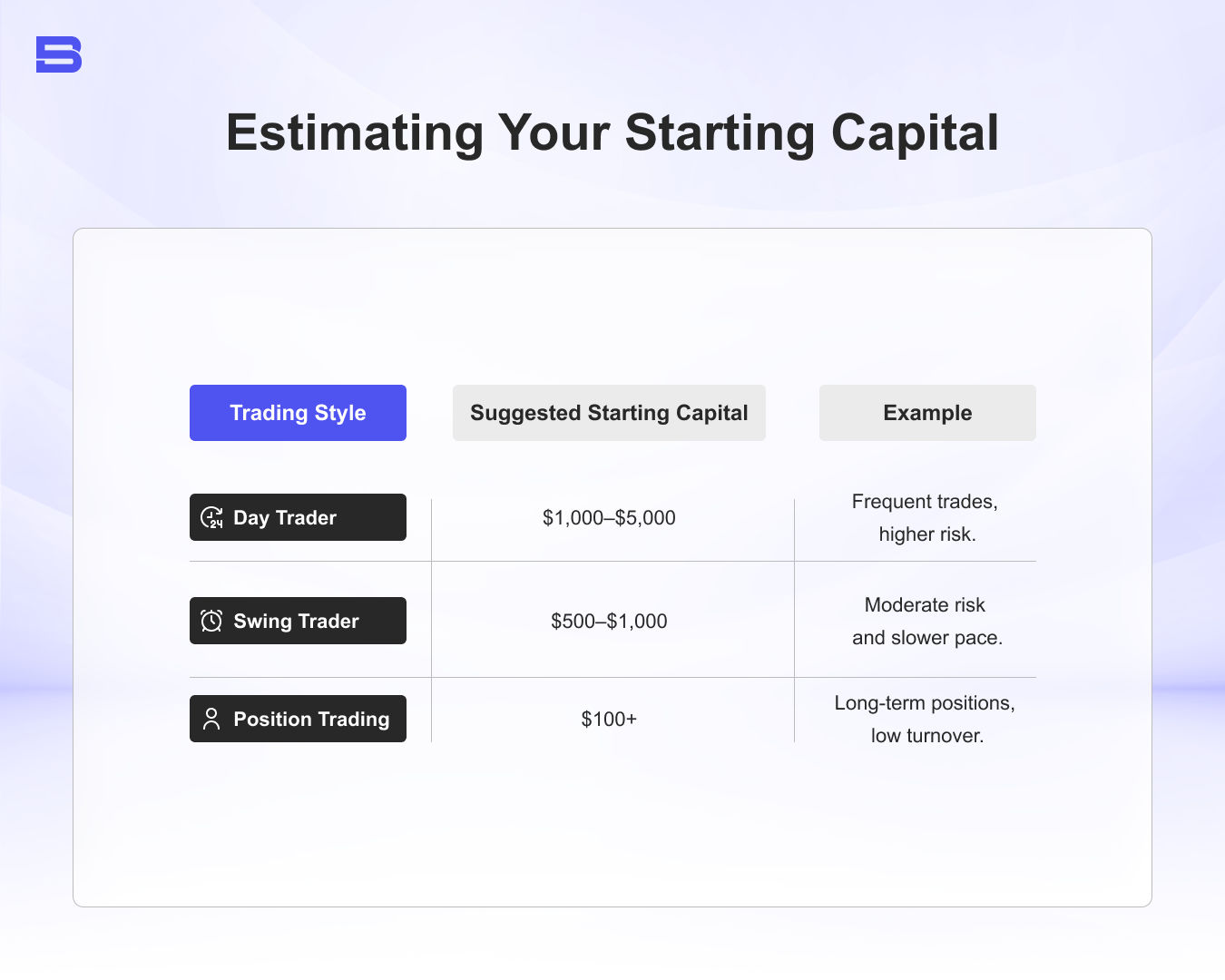
These aren’t hard rules—only benchmarks. What matters most is controlling risk and sizing your positions accordingly.
Short-term traders often trade more frequently and with higher leverage, hence requiring a bigger starting capital to keep their margin positions from being liquidated. At the other end of the spectrum, long-term investors don’t need as much capital to begin investing, as larger drawdowns are typical with a longer time horizon.
4. Focus on Managing Risk
Even small accounts can grow if you protect your capital and slowly scale upwards. Target a high risk-reward ratio and learn how to set position sizes and stop-loss levels that fit your account balance.
A good principle is to risk only 1–2% of your total capital per trade. For example, a $1,000 account should only risk $10–$20 per trade. This keeps you in the game even if you’re on a losing streak.
5. Consider Broker Minimums
Different brokers have different deposit requirements. Some require $100 to open an account, while others have no minimum at all. You can use our Find My Broker tool to compare regulated brokers by minimum deposit, fees, and account types to see which one suits your budget best.
6. Keep Costs in Mind
Trading involves managing costs, as this is the first barrier to overcome before you start seeing profits. Miscellaneous costs are especially important to consider when account balances are small. Brokers can charge you in a variety of ways:
- Spreads, commissions, and currency conversion charges
- Platform and data fees
- Withdrawal, overnight financing, and inactivity fees
A small account can work, but only if costs don’t heavily eat into your gains.
7. Build Up Gradually
Start small, focus on consistency, and scale only when you’ve proven that your approach works. Many traders make the mistake of thinking more capital automatically means more profit—but in reality, it often amplifies mistakes just as much as rewards.
When you begin trading with a modest account, the goal isn’t to make a fortune but to develop good habits: following your plan, managing risk, and keeping emotions under control.
Once you can consistently execute your strategy without impulsive decisions, that’s when adding more funds makes sense.
Final Thoughts
You don’t need thousands to start trading, but you do need discipline, patience, and a plan. Start in a demo, calculate your risk, and choose a broker that fits your capital and goals. If you don’t know where to start, check out our best broker reviews and decide based on your priorities.